NANO MAGIC'S JESTER HAS NANO BALLS
Nano Magic had the products. It had no brand to carry them. We built the character that put a stale category on notice and Nano Magic on big-box shelves.
Detroit, MI, USA

The Friction
Leadership could sense something was wrong and had a long list of suspects. Product wasn't moving like they expected, but couldn't solve it. asWas the packaging too busy? Was the hierarchy off? Was the messaging not landing? They couldn’t figure out their customer, so they decided to target everyone. Sales was lacking, so they contracted several rep groups. The board noticed social numbers were embarrassing, so the answer was to buy Instagram followers to look the part. Three times a year they poured money into a single ad and waited for it to change everything: $5,000, then $3,000, then $5,000 more at Christmas. Numerous agencies came aboard and built content off their own read of the market, and most of it came back safe and sounding like the competition.
The numbers matched the effort. 1 to 3 online orders a month. No repeat customers. No callbacks from buyers. A following made of friends and family liking posts, and bots bringing down the engagement rate. A 10% email open rate, and those opens were existing opticians who already bought from them. You could hear the tumbleweed rolling through the office. Marketing reached for fun while the sales team and the rep groups pitched in the same careful language the competitors used. The CEO was certain the problem was marketing, that the company kept pulling the wrong levers, and that one big win would change its course. He wanted a better campaign.
My opinion: the brand was lacking personality, clear differentiation, direction and ownership, and coherence throughout the company. A better campaign wasn't going to fix it.


The Diagnosis
Within six months, I moved into the Interim Marketing Director seat and was asked to build the marketing strategy. While I was digging into the competition, I noticed a trend. Safe on message, careful on subject, nearly identical on the shelf, all of it stale and institutional. Imagine walking into a bland, disinfected doctor's office in small-town America. Nano Magic claimed it was different for years, but it had difficulty showing up that way.
All of the things leadership pointed at were real, but they were just symptoms of a foundational problem. Sales playing it safe. Agencies producing content that landed flat because it was built to match the category. Fund those fixes and the company arrives at another version of the same lame duck. Big-box retailers already stocked every safe product they could carry, and they earn pennies on them. If there was any chance at breaking into retailers like Walmart, we needed to show them a product that can fly off the shelves. The challenge I proposed was differentiation, and it lived under everything leadership was debating week after week.

The Essence
Once the map was on the table, the discussion was over. My new mission: help Nano Magic become the brand that mocks the category. The obvious archetype was the jester. Fun, flamboyant, extra, full of life, un-serious, and sharp enough to land the joke. The problem with the Jester archetype is it can own a brand and go larger than life, but to fold it into Nano Magic, it needed a reason to exist, a backstory, a purpose that tied it to the people buying.
Introducing the Tony Stark character - an internal framework, never a public name. He turned the Jester into someone with quirks, guardrails, and depth, an inventor showman who is brilliant, self-aware, and built to evolve. Nano Magic’s founder was a comic and film buff who had floated Stark before, though he reached for the genius and philanthropy characteristics and missed the parts that could carry the brand. The useful Stark is the showman who makes hard science look like an effortless performance. That combination answered the only question the brand needed from then on. What would Nano Magic do? It would walk into the most boring aisle in the store, say the thing every competitor was too polite to say, with confidence and a smile, and back it with nanotechnology that works.


What would this brand do?
Make the category laugh, then beat it.
The Expression
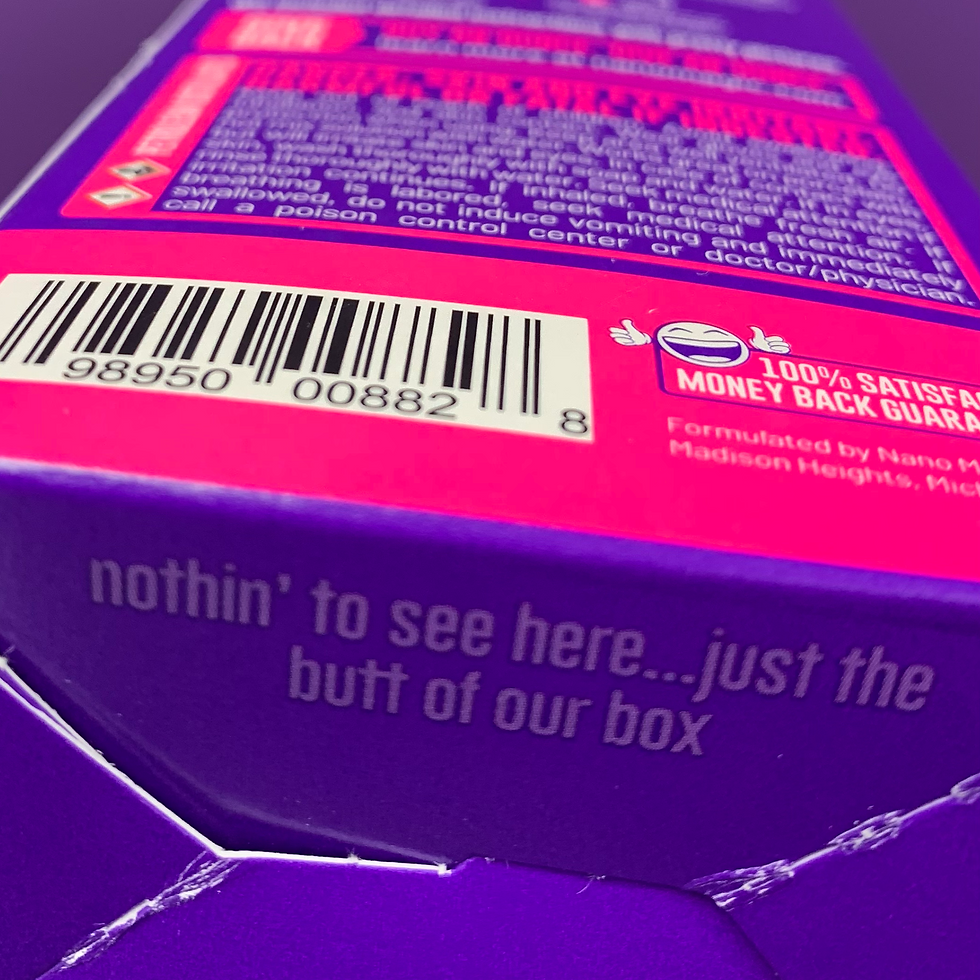
Packaging was the first update. Every agency contract, every marketing push, and every sales effort got paused, which was easy, since most of it was barely running. The almost fluorescent vibrant purple was Nano Magic’s biggest identity differentiator, so it stayed intact, and so did the product-category colors. However, they got pushed to brighter, more vibrant versions of themselves. When glancing down an aisle, that palette was the one thing that read as Nano Magic and nothing else. Once the required hierarchy and messaging were set, the easter eggs went in last, small rewards hidden for anyone paying attention, and enough that a shopper had to fight to put the box down. The same character later carried over to film in the two-minute spot, and the shelf is where it proved itself first.




The Transfer
For a long time, the Tony Stark character lived in two mouths: mine and the CEO's, plus a stack of examples. I ran the brand and creative, so more than 95% was executed by me: the packaging, website, blogs, campaigns, ads, sales decks, Amazon store, socials. There wasn’t much to hand off. But when someone did need to understand the brand, we showed them the work and talked them through Stark, and it landed almost on contact. Our national retail sales manager heard it once, smiled, and told me he understood. Then he vowed to stop fighting me on the sales decks, because he finally saw how Nano Magic could be fun, scientific, and larger than life at the same time. One exposure, and a skeptic re-pointed himself. That was character doing its job.
The brand held because I held it, and the CEO gave me near-total autonomy to keep holding it. The company was small enough that when brand decisions were discussed, I was in the room to make the call.
Once AI was released on the world, I realized I needed to put the brand down on paper...digital paper. After I had the character fully documented, I fed it to AI, and it returned on-brand tone and messaging right away, clean enough to run emails, blogs, and captions on minimal edits. Adding the full brand guidelines made the AI content sharper. When AI receives the proper context and behavioral systems, a company can produce content at scale, and it can help guide decisions that stay on brand. Nano Magic proved this is possible.


AI doesn't need your brand book.
It needs to know what your brand would do.
The Verdict
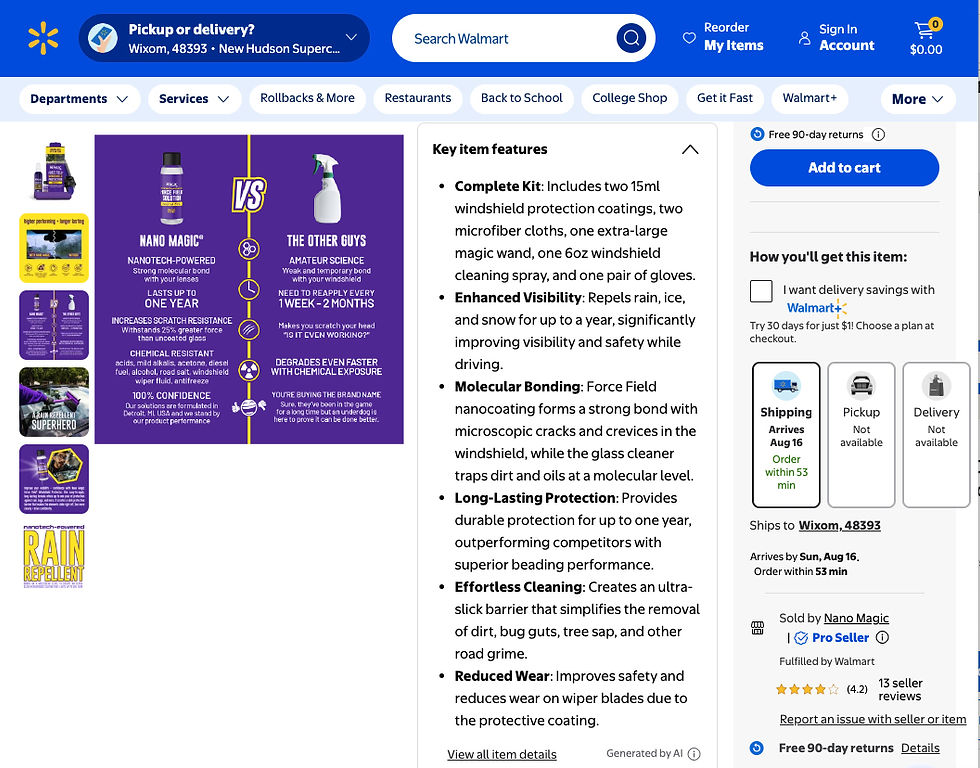
The Tony Stark character showed up and changed the business trajectory. Nano Magic booked $2.5 million in big-box retail purchase orders over eighteen months. Online, the store climbed from 1 to 3 orders a month to roughly 30 within a year, on zero ad spend, carried entirely by organic reach, word of mouth, and retail buyers converting to direct. A brand that could not get a callback started moving product into the exact retailers it had no business reaching, and character made it all happen.


What It Cost
The character made one promise on every shelf. Premium (well more premium than the competition). Superior and “Better Than Your X’s” (calling out Rain-X, Clorox, and Windex). Getting into Walmart meant meeting Walmart's price, and Walmart's price is a commodity price. To hold the account, the company cut its margin. So with thin margins, equipment went out of order, people got laid off, and quality control went down the drain. The product that reached the customer stopped matching the promise the brand made to get them there. The brand said premium and the shelf delivered frustration and disappointment. Winning back trust is an uphill climb wearing roller skates.
I held that brand with my own hands. I made almost all of it, with near-total autonomy, yet I couldn’t protect it. I heard about the pricing debate after the meeting. I remember it distinctly. Knowing that it should have been a brand decision, I fought it tooth and nail. But the decision was already made. I brushed it off and thought, “Maybe it won’t be that bad…we’ll win them over with our brand and superior product; then we’ll be pumping out so much product, we’ll make it back on sheer volume.” That one move brought the entire company to its knees.
That is the argument for distributed ownership in a single scar. A brand cannot survive held by the designer, the creative, or the brand owner alone. It has to be carried at the level where pricing, production, and operations make their calls, or those calls quietly overrule it. I build for that now. Brands the whole company can hold, and a system a machine can execute, so the brand keeps its vote in the rooms its owner never enters.
The Work
Brand Strategy • Creative Strategy • Brand Systemization
AI Enablement • Agency Lead
Brand Strategy • Creative Strategy
Brand Systemization
AI Enablement • Agency Lead